Le bruit d’à côté · Epilogue · 27/27
Epilogue — Taking Eugène for a walk
Six weeks after the exhibition, Liora discovered that certain cats could be walked in a harness.
The problem lay in the word certain.
I pointed this out.
Several times.
Calmly, at first.
Then with visual documentation, because Liora possessed the rare ability to listen to a reservation, nod, say, “Yes, I understand,” and then continue in precisely the opposite direction with renewed energy.
“Certain cats,” I repeated, “does not mean all cats.”
She was sitting on my couch with one leg folded beneath her and the other stretched across the rug. Her ankle was better. Not perfect, according to her. Perfect, according to her desire to run too quickly. The current compromise was to call it “functional,” which had the advantage of satisfying no one.
She held her phone in front of me.
On the screen, an orange cat walked along a sidewalk in a green harness, looking as though it had understood democracy.
“Look,” she said.
“I’m looking.”
“He looks happy.”
“He looks suspiciously cooperative.”
“Eugène might like it.”
At the sound of his name, Eugène raised his head from the armchair.
He looked at us.
For a long time.
Then went back to sleep.
A clear response.
“Eugène has already expressed his opinion,” I said.
“He doesn’t know what we’re offering yet.”
“That is precisely what concerns me.”
Liora placed her phone on the coffee table and leaned toward the cat.
“Eugène, do you want to discover the world?”
Eugène opened one eye.
Only one.
Not even the correct one.
“See?” she said. “He’s thinking.”
“He’s preparing a complaint.”
“He needs enrichment.”
“He has already enriched our building with a disappearance, a sprained ankle, and several family discussions.”
“Exactly. He has potential.”
I looked at her.
She smiled at me.
Not the way she had at the beginning.
Well, yes.
A little.
Still that smile that arrived before caution did.
But now she knew how to wait for my answer.
Sometimes.
When the idea did not involve a cat harness.
“You already bought the harness?”
She froze.
Barely.
Too barely.
“No.”
“Liora.”
“I ordered it.”
“Is that different?”
“Legally, perhaps.”
I covered my face with one hand.
Eugène, who had no access to the concept of online shopping, stood and climbed down from the armchair with insulting heaviness.
He came over, climbed onto the couch between Liora and me, then settled on my right knee.
He was never neutral.
Liora lowered her voice.
“He has just given emotional consent.”
“He has just immobilized me.”
“Close enough.”
The rabbit chewed a stalk of hay in his corner with the wisdom of an animal who had always known to avoid grand adventures.
I looked at him.
“At least you have ethics.”
His nose moved.
Liora followed my gaze.
“Demitrius doesn’t want a harness?”
“Demitrius wants this conversation to end.”
“I respect that.”
“So did Eugène.”
“Eugène doesn’t know what’s good for him.”
I stroked the cat, who was now purring with a remarkable lack of moral consistency.
“No one in this room knows what’s good for Eugène. Especially Eugène.”
The harness arrived two days later.
Red.
I had not been consulted about the color.
Liora claimed red looked very good with gray and white.
I replied that Eugène was not a couch requiring coordinated accessories.
She said that was exactly what someone opposed to aesthetic progress would say.
So the following Sunday, we organized Eugène’s first official outing.
The word organized was important.
It was not a walk.
It was an operation.
Liora’s father had come.
At first, I hadn’t understood why.
Then I saw him remove a small flashlight, a roll of plastic bags, a bottle of water, and a handwritten sheet titled “Cat Outing” from his pocket.
At that point, I stopped questioning his presence.
Her mother had come too, naturally.
She had brought cookies.
For us.
Not for the cat.
A necessary clarification, since Liora had asked.
We were all inside my studio.
Me, Liora, her parents, Eugène, Demitrius, and the red harness resting on the coffee table like a ceremonial object.
“We need to begin calmly,” Liora’s father said.
I looked around.
Four humans standing around a cat, one of them holding a written plan.
“We may already have moved beyond calm.”
“We must not transmit stress to him,” he continued.
Liora looked at me.
“Aurèl, stop transmitting.”
“I’m standing still.”
“You’re transmitting internally.”
Her mother smiled into her tea.
“She isn’t wrong.”
“Thank you, ma’am.”
“You can call me Marianne, you know.”
I froze.
She had offered her first name several times since the exhibition.
Each time, my system had filed the information under “process later.”
Liora looked toward the ceiling.
“Mom, you’re going to kill him.”
“With my first name?”
“He wasn’t ready.”
Liora’s father folded his sheet slightly.
“You can call me Alain as well.”
Silence.
I looked at them.
Marianne.
Alain.
Fine.
Parents had first names.
Logical information.
Destabilizing.
“Okay,” I said.
Liora smiled.
“You’ll use them in 2029.”
“Possibly.”
Eugène jumped down from the coffee table before anyone could begin.
The harness remained alone.
Very dignified.
“He understood,” Alain said.
“He’s anticipating.”
“That’s a sign of intelligence.”
“Or contempt.”
Liora crouched in front of Eugène, who had settled beside the bookcase.
“Come here, sweetheart.”
He looked at her.
He loved Liora.
In his way.
Meaning that he accepted existing near her whenever there was some tactile or nutritional benefit.
She pulled a treat from her pocket.
Betrayal.
“You had treats?”
“Of course.”
“Since when?”
“Since I decided to succeed.”
Eugène stood.
Bought.
Very quickly.
We managed to put the harness on him in three stages, two negotiations, one lie, and a remark from Alain about the importance of not twisting the straps.
Eugène immediately froze.
Completely.
Legs spread apart.
Body low.
Head upright.
Eyes fixed on me.
That look said:
You allowed this.
I lowered my eyes.
“I’m sorry.”
Liora, meanwhile, was emotional.
“He’s magnificent.”
“He looks like he’s wearing a debt.”
“He’s discovering a new sensation.”
“He has lost the use of his convictions.”
Eugène attempted one step.
The rest of his body followed late, as though the harness had altered the laws of feline coordination.
He stopped.
Looked at the floor.
Then at us.
Then the floor again.
“We need to give him time,” Marianne said.
“Yes,” Alain said. “Adaptation phase.”
I looked at him.
“There are phases?”
He raised his sheet.
“Three.”
Liora burst out laughing.
Eugène flattened himself slightly.
“Don’t laugh,” I said. “He’s undergoing an institutional crisis.”
Leaving the apartment took eight minutes.
Reaching the elevator took three.
Eugène walked as far as the doormat, then sat on it firmly.
Liora held the leash.
Not taut.
She had learned that from a video, probably.
“He needs to choose,” she said.
“He has chosen to remain here.”
“He’s assessing.”
“The doormat?”
“His territory.”
Alain crouched beside the cat.
“Eugène, you need to move forward.”
I looked at the scene.
An adult man, once feared as the administrator of emotional building regulations, was negotiating with my cat in a hallway.
Life had taken several turns.
Eugène turned his head away.
Alain stood.
“He does not respond to verbal instruction.”
“What a surprise,” I said.
Marianne placed one hand on my arm.
“Perhaps he responds to the atmosphere.”
“The atmosphere already owes him a great deal.”
Eventually, Eugène agreed to leave the doormat because Liora placed a treat six feet away.
Manipulation.
Effective.
We took the elevator.
Five people, one cat in a harness, a red leash, a folded instruction sheet, a package of cookies, and me in the middle holding the carrier in case of emergency.
The third-floor neighbor joined us.
He looked at Eugène.
Then at us.
Then at Eugène again.
“Hello.”
“Hello,” Liora replied with perfect seriousness.
He pointed toward the cat.
“A walk?”
“An attempt,” I said.
Eugène sat on my shoes.
The neighbor nodded as though that answered everything.
“Good luck.”
He left on the ground floor before we did.
Very wise.
In the lobby, Eugène regained some mobility.
He walked as far as the mailboxes.
Stopped.
Sniffed the base of an umbrella stand.
For a long time.
A very long time.
“He’s discovering the world,” Liora whispered.
“He’s discovering a piece of furniture that has existed for seven years.”
“It’s new to him.”
“It’s humiliating to us.”
Alain consulted his sheet.
“First outings should be brief. We aren’t aiming for distance.”
“Good news,” I said. “Neither is he.”
Marianne laughed softly.
The rabbit had remained in the studio.
Before leaving, I had seen him sitting peacefully in his corner, exempt from all modernity.
The thought reassured me.
The studio still existed.
Its quiet had not been invaded by the world.
It was waiting.
With the hay.
The rug.
The drawings on the desk.
An open life did not necessarily mean everything had to go outside at once.
We finally crossed the building’s front door.
The street was mild.
A clear afternoon, neither warm nor cold.
Pedestrians, bicycles, a stroller, an extremely small dog wearing a disproportionately large coat, a car parked too close to the crosswalk.
Eugène placed one paw on the sidewalk.
Then a second.
Then stopped.
He looked left.
Right.
Then behind him.
Like a property owner inspecting a neighborhood before investing.
“He’s impressed,” Liora said.
“He’s judging.”
“That’s how he expresses being impressed.”
We remained motionless in front of the building.
For a very long time.
A man passed, walked around us, looked at Eugène, and smiled.
“Is that a cat?”
I looked down at the gray-and-white animal wearing a red harness at the end of the leash Liora was holding.
“We believe so.”
The man laughed and continued walking.
Eugène took three steps.
Three.
Then stopped in front of a stone.
Small.
Gray.
With no visible appeal.
He lowered his head.
Sniffed it.
Walked around it.
Returned.
Sniffed it again.
“A historic moment,” Liora said.
“Contact with mineral matter.”
“Don’t make fun of him.”
“I’m documenting.”
Alain leaned forward.
“He appears uncertain about the direction.”
“He’s uncertain about everything,” I said. “It’s his ethical position.”
Marianne opened the package of cookies.
“Would anyone like one?”
Liora took a cookie.
So did I.
Alain declined, then took one two seconds later, which made his wife smile in an extremely married way.
Eugène suddenly decided to walk left.
We followed.
Well.
We took two steps.
Then he changed his mind.
Right.
Liora turned gently with him.
“We need to respect his rhythm.”
“His rhythm resembles a parliamentary debate.”
“You’re being unfair.”
“He has covered four feet in four minutes.”
“It’s a beginning.”
“It’s a cadastral survey.”
She laughed.
Her shoulder touched mine.
Naturally.
Without a question.
Alain walked six feet behind us, prepared to intervene if the outing turned into an incident.
Marianne walked beside him, cookie in hand, fully aware of the general absurdity but happy to inhabit it.
Eugène reached the base of a tree.
He appeared overwhelmed.
The tree maintained a professional attitude.
The cat placed one paw on a root.
Then another.
Sniffed the bark.
Looked up.
For one second, I saw a vertical project in his eyes.
“No,” I said.
Liora pulled very gently on the leash.
“Not the tree.”
Eugène looked at us.
“Not after everything we’ve been through,” I added.
Alain approached.
“He might try to climb.”
“Thank you, Alain.”
The name came out.
Everyone turned toward me.
Terrible.
I had used it.
Alain looked satisfied, almost imperceptibly.
Liora stared at me with an enormous smile.
“You did it.”
“Accidentally.”
“Too late.”
Marianne smiled too.
“Remarkable progress.”
I looked at Eugène.
“This is all your fault.”
He ignored the comment and stepped down from the root.
We resumed the walk.
The word remained generous.
Eugène advanced in twelve-inch sequences, interrupted by lengthy field studies.
A leaf.
A water stain.
A cigarette butt.
A ventilation grate.
The last caused a complete halt.
He stared into the openings as though they contained a fundamental answer.
Liora crouched beside him.
“Do you hear something?”
Eugène didn’t move.
“Maybe pipes,” I said.
“He’s sensitive to the city.”
“He’s sensitive to places he shouldn’t enter.”
A scooter passed along the street.
Eugène immediately lowered himself, belly close to the ground.
I stepped forward.
Liora raised one hand without looking at me.
Not now.
She didn’t say the words.
She made me feel them.
She remained crouched.
Calm.
“It’s okay, sweetheart.”
Her voice was low.
Not the voice that pushed.
Not the voice that wanted to move the world more quickly.
A voice that stayed with him.
Eugène raised his head after a few seconds.
I looked at Liora.
Her hair fell beside one cheek, the leash in one hand, her coat slightly open, her ankle still cautious when she stood.
She was still herself.
Quick.
Sometimes impatient.
Capable of deciding that a cat needed to discover outdoor civilization.
But now she knew how to wait three seconds longer.
Sometimes, that was enormous.
She stood.
“See? He handled it.”
“He’s recovering from a scooter.”
“Everyone has their traumas.”
“He has mainly traumatized other people.”
Alain checked the time.
“We should not exceed ten minutes outside on the first attempt.”
Liora looked around.
“How long have we been out?”
“Seventeen minutes,” he replied.
Silence.
“Why didn’t you say anything?”
“I was observing.”
“You have a sheet.”
“Exactly. I’m collecting data.”
Marianne laughed openly this time.
“Alain, let the cat have his achievement.”
“I am letting him have it. Within a framework.”
“Naturally.”
Eugène walked another six feet.
Then sat in the middle of the sidewalk.
Abruptly.
Definitively.
Body upright.
Tail wrapped around his paws.
Gaze fixed on the street.
The walk was over.
Not because we had decided.
Because he had decreed it.
A woman carrying a shopping bag stopped.
“Oh, he’s beautiful.”
Eugène didn’t react.
“Thank you,” Liora said, as though she had produced him.
“Is he good at walking?”
I looked at the motionless cat.
Liora replied:
“He’s a beginner.”
A charitable formulation.
The woman smiled and continued on her way.
The four of us remained gathered around Eugène.
Alain assessed the situation.
“We can try calling him.”
“Eugène,” Liora said. “Come on.”
Nothing.
“Eugène,” I said.
Nothing.
Marianne suggested:
“Perhaps carry him?”
Alain frowned slightly.
“We should avoid responding to every refusal by carrying him, or he’ll learn that immobility produces results.”
I looked at him.
“Do you think he doesn’t already know that?”
Alain considered Eugène.
“Valid point.”
Liora crouched in front of the cat.
“Sweetheart, if you walk to the door, I’ll give you a treat.”
Eugène blinked.
“He’s negotiating,” she said.
“No. He’s waiting for the offer to increase.”
“Two treats.”
Eugène licked himself.
“He drives a hard bargain,” Marianne said.
I crouched too.
“Eugène.”
He looked at me.
I adopted a very serious tone.
“We need to go home before you discover freedom.”
Liora turned toward me.
Her smile arrived slowly.
“Too late. He discovered a stone. That’s already a lot.”
“He’ll never recover.”
“Neither will we.”
Alain finally bent down carefully.
“I’ll carry him to the lobby.”
“Watch his back legs,” Liora said.
“I know how to carry a cat.”
She looked at me.
“Does he?”
“I cannot answer without creating family tension.”
Alain picked Eugène up.
Eugène allowed it with offended dignity, as though the idea had been his and we were merely carrying out his instructions.
The leash hung down.
The red harness shone in the sunlight.
An adult cat, perfectly capable of walking but morally unavailable, was carried twelve feet by a serious man while his daughter laughed and his wife ate a cookie.
I looked at the scene.
Absurd.
Ordinary.
Exactly the right size.
Liora moved beside me.
Her hand searched for mine.
I took it.
Not to mark anything.
Because it was there.
The street continued around us.
A bicycle passed.
A door slammed.
A conversation drifted down from a window.
Alain was explaining to Eugène that a walk needed to include a return journey, not only exploration.
Marianne smiled in silence.
Liora laughed softly beside me.
The neighborhood made its ordinary noise.
There had been a time when I would have heard all of it as an invasion.
Proof that the world did not know how to remain in its proper place.
Now I heard it differently.
Not always easily.
Not without fatigue.
Not without occasionally wanting to go home, close the door, and return to Demitrius, my desk, the lamp, the quiet of the studio.
But I didn’t need it to stop.
That was new.
And rather good.
Inside the lobby, Alain placed Eugène on the floor.
The cat immediately walked toward the elevator with scandalous confidence.
“Oh,” Liora said. “Now he knows how to walk.”
“He was conserving his strength,” Alain replied.
“To press the button?”
Eugène sat in front of the doors.
I sighed.
“He’s going to demand to be carried all the way to the couch.”
“He has high standards,” Liora said.
“He’s judging us.”
“Of course. He has always judged us.”
She rested her head against my shoulder for one second.
Very quickly.
The way she sometimes did now, in the middle of a sentence, a hallway, a noise.
I looked at Eugène, the red harness, the leash, Liora’s parents, and the reflection of all of us in the elevator doors.
The rabbit was waiting for us upstairs.
So was the studio.
With its quiet.
With enough room now for other presences to enter without displacing everything.
The elevator arrived.
Eugène entered first.
Obviously.
We followed him.
Beside me, Liora was still laughing. Alain was explaining something about the optimal duration of future outings. Marianne was telling him they would see. The city continued beyond the glass doors.
I didn’t need it to stop.
I tightened my hold on Liora’s hand.
She squeezed mine in return.
And Eugène, in the middle of the elevator, looked deeply satisfied for an animal who had just taken four humans for a walk.
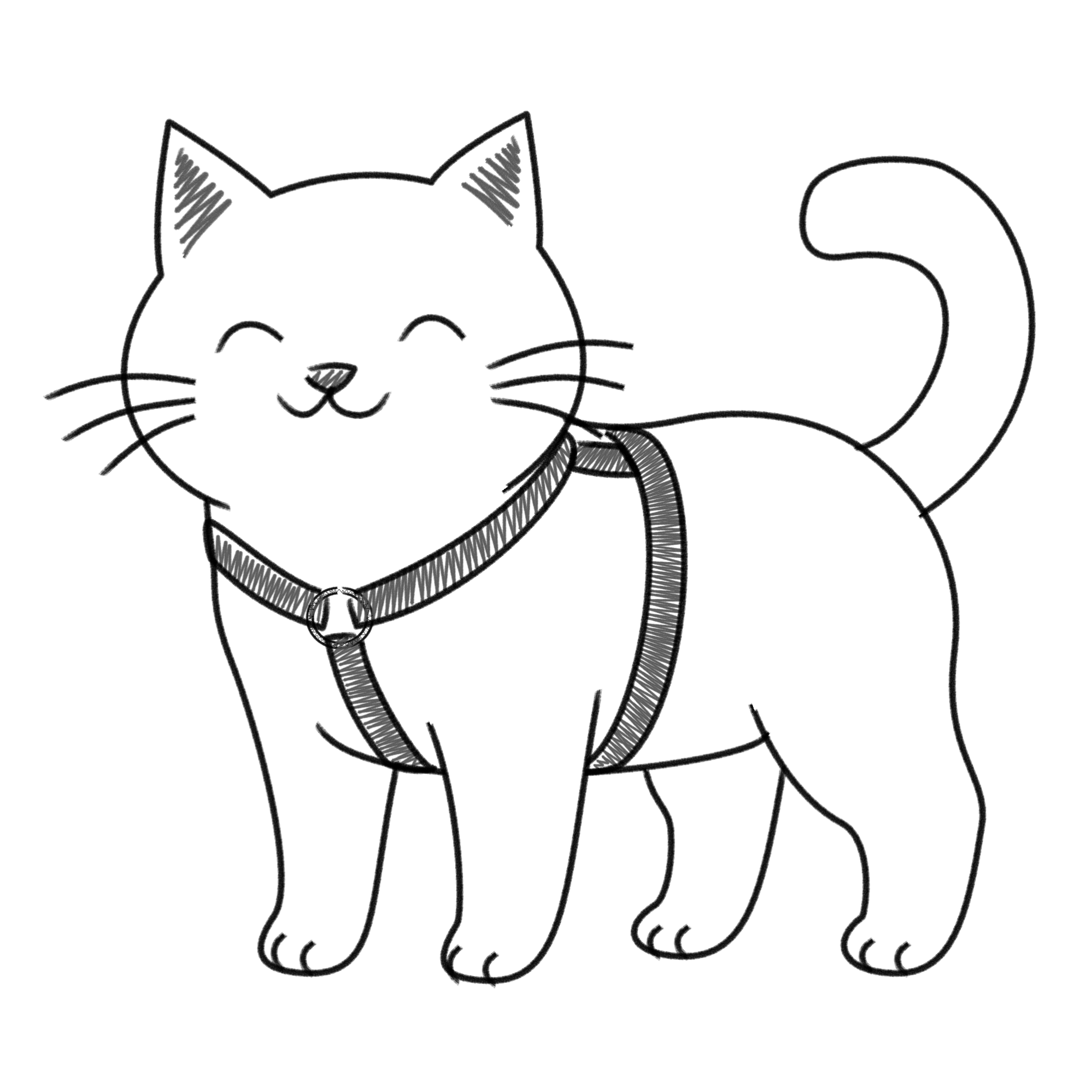
Table of contents
- Prologue
- Chapter 1 — Trespassing
- Chapter 2 — The father, the cat, and me
- Chapter 3 — Selective allergy
- Chapter 4 — Repeat offense
- Chapter 5 — A feline excuse
- Chapter 6 — The rabbit, and other evidence
- Chapter 7 — What she leaves behind
- Chapter 8 — Four hundred meters too far
- Chapter 9 — The things you hear without listening
- Chapter 10 — The balcony doesn’t count as an invitation
- Chapter 11 — A father questions
- Chapter 12 — What remains in the sketchbooks
- Chapter 13 — Second lap
- Chapter 14 — Almost
- Chapter 15 — A generation trapped inside
- Chapter 16 — What you call running away
- Chapter 17 — Taking his name off
- Chapter 18 — Eugène doesn’t answer
- Chapter 19 — Too high
- Chapter 20 — Doing nothing
- Chapter 21 — The next day happens anyway
- Chapter 22 — Running differently
- Chapter 23 — The right caption
- Chapter 24 — Two laps
- End
- Epilogue — Taking Eugène for a walk